
If you walk into a health food store or scroll through a wellness feed, you’ll see shelves lined with supplements labeled as “probiotic blends,” “prebiotic fiber,” or the new and trendy name—“postbiotics.”
The gut health industry is expanding rapidly, with the global market for these products worth more than $57 billion in 2023 and projected to grow at an annual rate of 7% through 2030. But beneath the slick marketing hype, what does the science really say about prebiotics, probiotics, and postbiotics? Do they really work? And if they do, for whom, and how?
Let’s cut through the noise and take a clear look at what the research actually reveals about the “biotics” family.
Key Takeaways
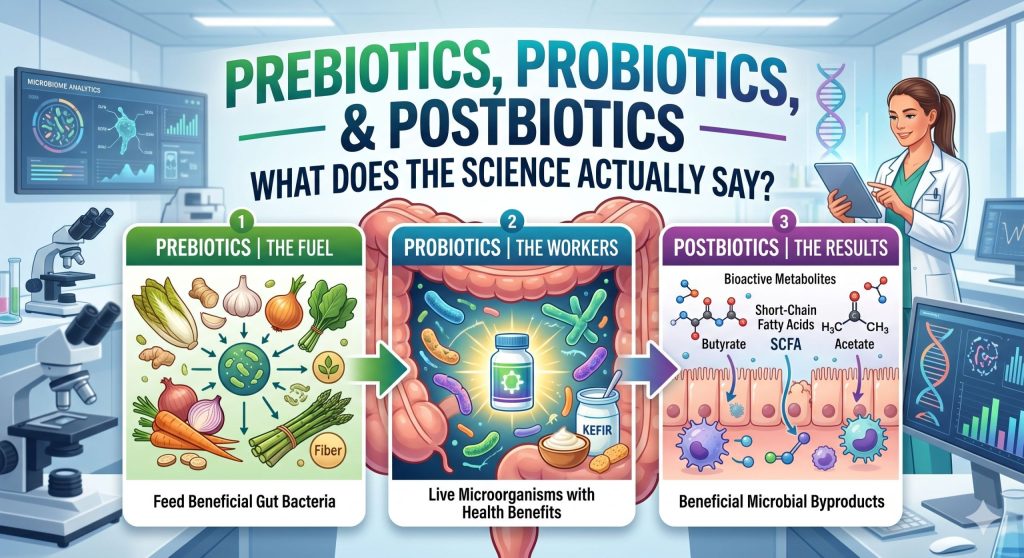
- The Gut Ecosystem: Your gut is a complex environment that requires a delicate balance of fuel, live workers, and beneficial byproducts to function optimally.
- Prebiotics (The Fuel): Indigestible fibers that feed the good bacteria already living in your gut.
- Probiotics (The Workers): Live, beneficial microorganisms introduced to your digestive system through fermented foods or supplements to confer a health benefit.
- Postbiotics (The Goods): The beneficial byproducts (like short-chain fatty acids) created when probiotics consume prebiotics.
- Synergy is Key: A healthy diet and lifestyle naturally integrate all three. Focusing entirely on one while ignoring the others limits their effectiveness.
The Gut Microbiome: A Quick Primer
Before we can fully understand the unique roles of these “biotics,” we need to understand the environment in which they operate: the human gut microbiome. The large intestine is home to an estimated 38 trillion microorganisms, including bacteria, fungi, viruses, and archaea. Collectively, these microorganisms weigh about the same as your brain and act almost like an extra organ.
A healthy and diverse microbiome helps digest food, synthesize essential vitamins (such as vitamin K and various B vitamins), regulate the immune system (about 70% of which is in the gut), and even produces neurotransmitters like serotonin and dopamine that communicate directly with the brain via the vagus nerve.
However, unhealthy eating habits, chronic stress, lack of sleep, and overuse of antibiotics can lead to dysbiosis. This is an imbalance in which harmful microorganisms outnumber beneficial microorganisms. This dysbiosis is linked to irritable bowel syndrome (IBS), inflammatory bowel disease (IBD), obesity, allergies, and even depression. Understanding this delicate balance is where prebiotics, probiotics, and postbiotics can work their magic.
If you want to dive deeper into how your microbiome influences your mental well-being and rest, check out our comprehensive guide on The Gut-Brain Connection: How Your Diet Affects Sleep and Anxiety.
Prebiotics: The Fertilizers of the Gut
Prebiotics are types of plant fiber that the human body cannot digest. In 1995, researchers Glenn Gibson and Marcel Roberfroid defined prebiotics as substances that have a beneficial effect on the host by selectively stimulating the growth of beneficial bacteria in the gut.
Since we don’t have the enzymes needed to break them down in the stomach or small intestine, they pass intact into the colon. Once there, they host a feast for your beneficial bacteria.
What the Science Says:
Not all types of fiber are prebiotics. To be scientifically classified as a prebiotic, a compound must withstand stomach acidity, be fermentable by gut microbes, and selectively stimulate the growth or activity of gut bacteria that are beneficial for health.
The most heavily researched prebiotics include:
Fructooligosaccharides (FOS) and inulin: Found in abundance in chicory root, onions, and garlic.
Galactooligosaccharides (GOS): Often found in legumes and grains like beans. Resistant Starch: Found in raw bananas, oats, and cooked and cooled potatoes or rice.
Where to Find Them:
You don’t need a powder to get prebiotics. They’re found in abundance in whole foods:
- Jerusalem artichokes.
- Garlic, onions, and leeks.
- Asparagus.
- Bananas (especially mildly overripe bananas).
- Barley and oats.
- Apples (especially the pectin in their peels).
Probiotics: The Living Members
Probiotics are live microorganisms that, when administered in adequate amounts, confer a health benefit on the recipient. The World Health Organization (WHO) defines probiotics as “live microorganisms that, when administered in adequate amounts, confer a health benefit on the recipient.” Examples: Lactobacillus and Bifidobacterium strains found in yogurt, kefir, sauerkraut, and dietary supplements.
What the Science Says:
The science of probiotics is largely strain-specific. This is where many consumers get confused. Saying “probiotics are good for you” is a bit like saying “medicine is good for you”—it all depends on the medicine and the condition it is used for.
Probiotics are identified by their genus, species, and strain. For example, in the case of Lactobacillus rhamnosus GG, “Lactobacillus” is the genus, “rhamnosus” is the species, and “GG” is the specific strain.
- For antibiotic-associated diarrhea: There is strong clinical evidence that the yeast Saccharomyces boulardii and the bacterium Lactobacillus rhamnosus GG can prevent common antibiotic-associated diarrhea.
- For irritable bowel syndrome (IBS): Strains such as Bifidobacterium infantis 35624 have been clinically proven to reduce bloating, gas, and abdominal pain in IBS patients.
- To boost immunity: Certain strains of Lactobacillus and Bifidobacterium have been shown to help reduce the duration and severity of common respiratory infections.
A common misconception:
Not all fermented foods are probiotics. While foods like kombucha, unpasteurized sauerkraut, and kimchi are extremely healthy and contain live cultures, they rarely include the specific clinically researched strains or the exact colony-forming units (CFU) needed to meet the scientific definition of probiotics. They are great for general well-being, but they are not used to treat any specific disease.
Postbiotics: The End Products
Postbiotics are the newest member of this family. Recently, the International Scientific Association for Probiotics and Prebiotics (ISAPP) officially defined postbiotics as: “A preparation of live microorganisms and/or their components that confers a health benefit to the host.” Simply put, postbiotics include dead bacterial cells, cell wall fragments, enzymes, peptides, and organic acids that remain after fermentation.
What the Science Says
Science is beginning to realize that the beneficial effects of probiotics are largely due to the postbiotics they produce. You don’t necessarily need the live bacteria if you can administer the beneficial chemicals they produce directly.
The most well-studied postbiotics are Short-Chain Fatty Acids (SCFAs), particularly:
Butyrate: This is the main source of energy for the cells inside your colon (colonocytes). Butyrate is a powerful anti-inflammatory. It strengthens the tight junctions in the intestinal lining, prevents “leaky gut” (intestinal permeability), and has been studied extensively for its potential to prevent colorectal cancer.
Propionate: This is involved in glucose production in the liver and plays a role in signaling fullness and satiety, which can help with weight management.
Acetate: The most abundant SCFA, which is used for energy and cholesterol metabolism.
A huge advantage of postbiotics over probiotics is their stability. Since they are not alive, they do not need to be refrigerated, they have a long shelf life, and they do not cause any infections. As a result, they are completely safe, even for those with severely weakened immune systems and those who cannot tolerate live probiotics. This stabilization completes the cycle of prebiotics, probiotics, and postbiotics, providing a highly reliable means of protecting gut health.
The Synergy: Working Together
The real power of these concepts lies not in their isolation, but in their combination. The synergistic action of prebiotics, probiotics, and postbiotics is what builds a strong immune system and a healthy digestive system.
You don’t necessarily need a huge medicine cabinet to include all the ingredients of prebiotics, probiotics, and postbiotics in your lifestyle. You can make synbiotic foods in your own kitchen:
- Add oats and raw banana (prebiotic) to yogurt (probiotic), which will be digested to produce SCFAs (postbiotics).
- Blend kefir (probiotic) with apples and chia seeds (prebiotics).
- Salad made with chicory greens and onions (prebiotics), served with a portion of raw, unpasteurized sauerkraut (probiotic).
Navigating Supplements: What to Look For
When it comes to buying prebiotic, probiotic, and postbiotic supplements, the market is notoriously poorly regulated. Keep these rules in mind to make sure you’re getting a product that’s backed by real science:
Check strain transparency: A good probiotic will list the genus, species, and strain (e.g., Lactobacillus acidophilus NCFM) on the back of the bottle. If it just says “Lactobacillus,” throw it away.
Check the CFU count at the end of the shelf life: The bottle should state the number of colony-forming units (usually between 1 billion and 50 billion) at the end of its shelf life, not just the “date of manufacture.”
Ensure viability: Look for products that have delayed-release capsules or enteric coatings, which protect the live bacteria from the harsh acids in your stomach.
Choose a strain based on your symptoms: As discussed, the clinical evidence for prebiotics, probiotics, and postbiotics is limited. If your goal is to boost your immune system during the winter, don’t take a strain that is clinically proven for IBS. Research the specific strain for your specific health goals.
The Honest Limitations: What We Still Don’t Know
Despite exciting advances, intellectual integrity requires that science still lags behind the hype.
- Many probiotic studies have had small sample sizes, short durations, and heterogeneous populations, making it difficult to generalize the results.
- We still don’t have a standard protocol for postbiotics — i.e., there is no clear definition of what compounds are included, how to measure levels, and what counts as effective for specific health outcomes.
- The idea of a single ‘healthy gut’ microbiome may be a myth. Research presented at Probiota 2025 challenges the conventional wisdom, emphasizing that there is no single standard definition of a healthy gut.
Finally, the question of the long-term safety and optimal dosage of both prebiotics and postbiotics in different clinical populations remains largely unresolved. More rigorous and long-term human trials are urgently needed.
Practical Takeaways: What Should You Actually Do?
Based on what the science shows, here are some practical things you can do to keep in mind:
- Prioritize prebiotic-rich foods first. Before taking any supplements, focus on a varied and fiber-rich diet. Foods like garlic, onions, oats, legumes, and bananas provide natural prebiotic fiber that supports your gut microbiome in a consistent and well-supported way.
- Choose probiotics wisely and for specific purposes. Evidence-based strains like Lactobacillus rhamnosus GG or Bifidobacterium longum for specific conditions can be a good start, but consult a healthcare provider.
- Keep an eye on postbiotics. Postbiotics are the most promising area of probiotic science. As standards and research mature, they could be a more reliable, stable, and safe alternative to live probiotic supplements — especially for at-risk populations.
- Think long-term and holistically. Your gut microbiome is shaped by everything: what you eat, how you sleep, your stress levels, physical activity, and antibiotic use. No supplement can replace a gut-healthy lifestyle.
Frequently Asked Questions (FAQ)
1. Can I get enough prebiotics, probiotics, and postbiotics from food alone?
Answer: Absolutely. For the average healthy person, a diet rich in a variety of plant-based fiber (fruits, vegetables, legumes, whole grains) and regular consumption of fermented foods (kefir, yogurt, kimchi, miso) provides enough energy and beneficial microorganisms to naturally produce postbiotics.
2. Are prebiotics, probiotics, and postbiotics safe for everyone?
Answer: Generally, yes, they are safe for most people. However, those with Small Intestinal Bacterial Overgrowth (SIBO) may find that prebiotics and probiotics exacerbate their symptoms (which can lead to severe bloating and gas).
3. How long does it take for prebiotics, probiotics, and postbiotics to work?
Answer: This depends entirely on the problem you are trying to solve. For chronic conditions such as IBS, gut barrier repair, or immune system changes, it usually takes 4 to 12 weeks of regular daily use (along with dietary changes) to see noticeable and therapeutic improvement.
4. Should I take probiotics on an empty stomach or with food?
Answer: The science is somewhat mixed on this issue, and it often depends on the specific capsule design. However, a general rule of thumb supported by research is to take probiotics just before or with a fatty meal.


5 Responses
https://shorturl.fm/wrAXj
Thank u for your comment
https://shorturl.fm/9Ykei
Thank you for your comment
Nice